Context
During my Master's in International Business at KU Leuven, I wanted to stay connected to the energy sector while exploring its business and economic aspects.
A previous personal project involving the reuse of an end-of-life e-bike battery introduced me to the concept of second-life batteries. The idea of extending the lifetime of batteries instead of recycling them immediately caught my interest, which led me to propose this topic for my master's thesis.
Goal
After an initial review of the literature, it quickly became clear that second-life batteries were unlikely to remain competitive against new batteries in the long term due to the rapid decrease in battery costs.
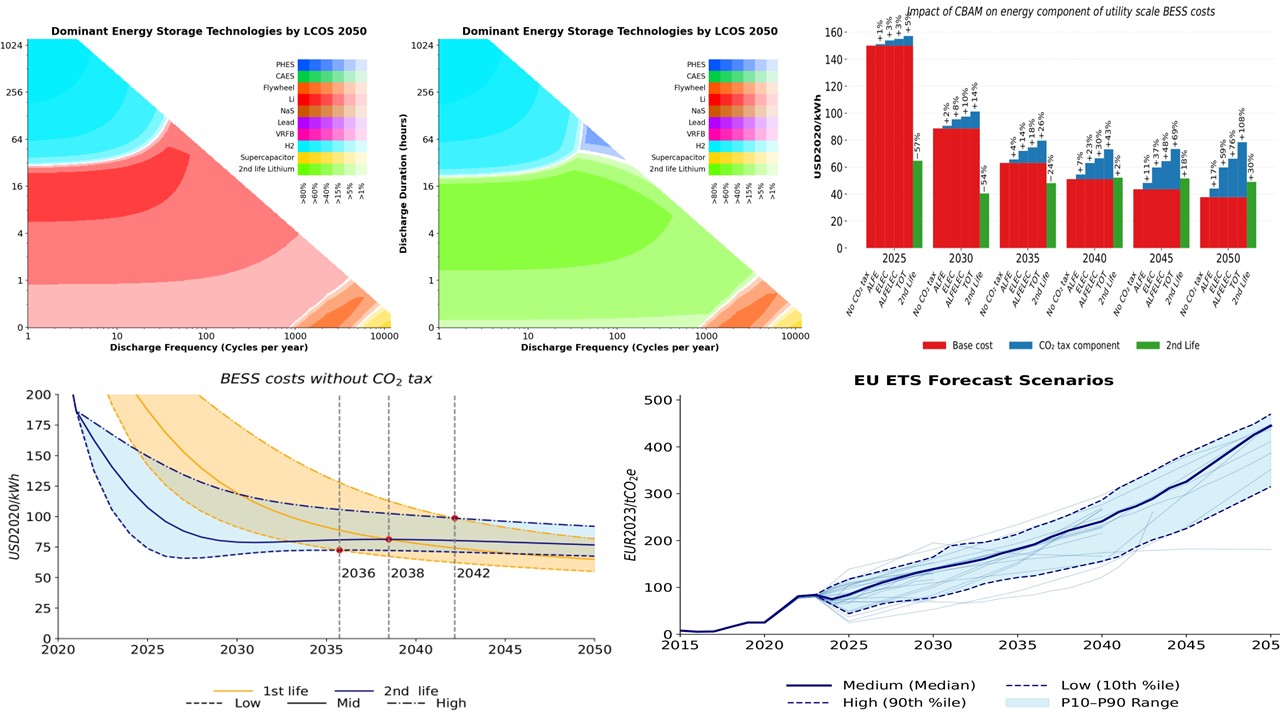
I therefore decided to investigate whether their lower environmental impact could become a financial advantage. This led me to study how carbon pricing policies, and in particular the Carbon Border Adjustment Mechanism (CBAM), could affect the competitiveness of second-life batteries.
What I Did
I first conducted a literature review covering batteries, second-life batteries, energy storage technologies, storage economics, and environmental impacts.
I then selected the Levelized Cost of Storage (LCOS) methodology as the main framework for comparing storage technologies and combined it with learning curves to forecast future battery costs.
To evaluate future carbon pricing, I built my own forecast of the European carbon market (EU ETS) by aggregating multiple forecasts from the literature.
I also developed a methodology to estimate the future cost of second-life batteries, defined several realistic carbon taxation scenarios inspired by CBAM, and integrated all these elements into a Python-based LCOS model.
Finally, I analysed the results and derived conclusions regarding the future competitiveness of second-life batteries.
Results
The analysis showed that, without additional incentives, second-life batteries are likely to progressively lose competitiveness as new battery costs continue to decrease.
However, the study also demonstrated that carbon pricing policies could significantly improve their competitiveness. Under some scenarios, second-life batteries even become the most attractive economic option for energy storage applications.
More broadly, the project highlighted how environmental regulations can strongly influence industrial competitiveness and reshape the future of the battery sector.
If you are interested in more details, my thesis is available at the following link, and you can always contact me.
Tools Used
- Python
- Excel
- Economic modelling
- Statistical analysis
- LCOS (Levelized Cost of Storage)
- Cost forecasting and learning curves
- Scenario analysis
- Battery market research
- Energy policy analysis
- Scientific literature review
What I Learned
This project allowed me to combine my engineering background with business and economic analysis. I learned how to build a complete economic model, perform long-term forecasting, evaluate policy impacts, and transform large amounts of technical and economic information into actionable conclusions.